

I first met Sister Louise two years ago at the Good Shepherd Sisters in Bangkok, Thailand, and we became fast friends. I was pleased to visit with her again during my recent assignment to Asia.

Latter-day Saints are encouraged to exercise, eat healthy, interact with others, and use their own initiative to do good in the world. The Church of Jesus Christ of Latter-day Saints offers structure and programs that facilitate these activities.
An article in the Wall St. Journal discusses some of the science behind the benefits of these activities.
‘Social Prescriptions’: A Good RFK Jr. Idea
Exercise, nutrition, art and connection can all help keep people healthy.
By Julia Hotz Nov. 19, 2024
Excerpts:
Robert F. Kennedy Jr.'s... stated mission—to end chronic disease by treating root causes—is supported by data showing 80% of our health is determined by behavioral, social and environmental factors.
...
Leaders in Massachusetts, New Jersey, Vermont and Utah have created programs effectively prescribing art, nature and social connection.
The idea is called “social prescriptions”—healthcare referrals for nonmedical, community-based resources and activities. Instead of focusing on “What’s the matter with you?” health workers ask “What matters to you?” and offer a social prescription—sports lessons, art classes, or even food and job support—connected to that answer.
A recent analysis of 14,000 people highlighted the effectiveness of exercise as treatment for depression, while another found nature-based physical activity prevented nearly 13,000 cases of noncommunicable diseases like heart disease and cancer. Large-scale analyses associate arts engagement and volunteering with improved stress management and cognitive functioning in older adults and longevity. And tons of longitudinal data find that strong social connections, the ultimate goal of many social prescriptions, help people live longer. Social prescribing also eases pressure and spending on healthcare by reducing doctor and emergency-room visits, as evidenced already in the U.K., where it is more widely used.
Beyond the data, in my reporting around the world, I’ve seen firsthand how social prescribing can help otherwise hopeless patients feel better. I’ve seen it in people like Frank, whose cycling prescription helped him lose 40 pounds, come off his insulin, and make friends; Akeela, whose prescription for volunteer work helped curb her back pain and depression and find a new sense of purpose; and Glenn, whose prescription for a phone-call buddy helped him overcome loneliness and take steps to manage his own health.
Social prescriptions are no panacea. But if the Trump administration is serious about ending chronic disease, it would be wise to invest in social prescribing as a safe, bipartisan way to create chronic health. Especially as political extremism drives us further apart, social prescribing can reconnect us to each other.
Ms. Hotz is author of The Connection Cure: The Prescriptive Power of Movement, Nature, Art, Service and Belonging.

It made sense to be pessimistic in the past. But modern society is far safer, with limited downside and unlimited upside. Adapting for modern society means overriding your natural pessimism.
BYU Pathway is changing the world.

https://www.deseret.com/opinion/2024/07/08/spiritual-mandate-education-innovation-ces-byu/
The nation’s higher education establishment is dealing with much more than a passing PR problem. From rising costs to questions about relevance and the very definition of moral character, recapturing public trust will demand substantive action and innovation. Parents, students and employers are looking for academic institutions to better reflect the needs and values of their communities.
It is in this climate that the distinctive educational offerings provided through The Church of Jesus Christ of Latter-day Saints are of increasing relevance and value. Enrollment in the Church Educational System continues to defy declining national trends — over the past 20 years, enrollment in church universities, including BYU, BYU-Idaho and BYU-Pathway, has grown nearly threefold, increasing from 60,000 students in 2000 to nearly 150,000 students today.
At a time when national observers are concerned about the demand for higher education, this growth stands out from the downward trends. Just over a decade ago, Pew reported that an overwhelming majority of college graduates (86%) said their degree was “a good investment for them personally.” But this year, Pew released a report that suggests that a mere 1 in 4 adults in the United States believe it’s “extremely or very important” to get a four-year degree in order to obtain “well-paying” employment. Almost 50% of Americans say a four-year diploma is less important for employment than it was 20 years ago. Whereas rates of college attendance are increasing in other nations, the United States is in a 13-year slide.
Negative attitudes toward higher education reflect two trends. First, spiraling tuition prices are increasing the total cost of attendance, and second, too much of higher education is not relevant to today’s job market. Additionally, in some corners, the academy has become increasingly governed by agendas that don’t reflect the moral values of most American families.
In such a setting, CES provides a unique resource through its faith-based governance and spiritual mission. CES’s governance, financial stewardship and innovative approaches have kept the church’s educational offerings both affordable and relevant, especially in a season of uncertainty.
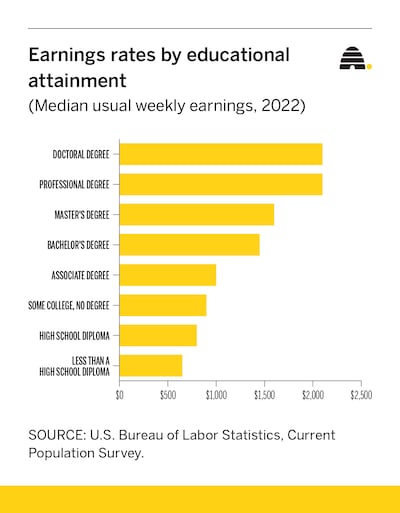
The benefits of a college degree include increased self-reliance, enhanced reasoning abilities, higher civic and community engagement, broader social networks, higher marriage rates and deepened appreciation for different perspectives. Extensive data show college graduates have substantially higher earnings throughout their career than those who don’t have a college degree. In short, education remains a good value proposition overall.
Of course, the value of an education only increases as costs are managed and student benefits are strengthened. Costs can be measured not only in the tuition price but also in time to graduation and the amount of debt required to obtain a degree. In turn, benefits are strengthened through increased learning, impactful social networks and professional opportunities. Innovation on the campuses of BYU, BYU-Idaho and other church institutes are distinctively helping increase the value of a degree by managing both the costs and increasing the benefits of an education.

On cost and affordability, the church’s governance of its education system has kept the student expenses remarkably affordable. Church schools receive significant and generous tithing support, but they have also been expected to innovate in ways that keep the actual costs financially sustainable.
It’s one thing to be committed to affordable education through subsidies such as tithing, taxes and donations. It’s another to answer the call from inspired church leaders to innovate in service of students and society. Such efforts have led to the year-round, three-track calendar at BYU-Idaho; online learning and the use of distributed chapels through BYU-Pathway; reducing time on campus at BYU-Hawaii by leveraging early academic progress in BYU-Pathway and launching a 90-credit bachelor’s degree at Ensign, BYU-Idaho and BYU-Pathway.
There is also a fiscal discipline that’s visible across CES. The foundations of this discipline were laid generations before any of us assumed our current assignments. Those principles of frugality were practiced over a generation of leadership, where variable expenditures were held below inflationary increases. These small differences, applied over decades, have also helped to support the affordable college tuition our students realize today.
Indeed, church schools provide some of the most affordable post-secondary educational opportunities. U.S. News has ranked BYU No. 2 in the country in graduates with the least amount of debt, and No. 11 as the best value school. BYU is No. 20 in the Best Colleges in America rankings from The Wall Street Journal, which puts a very strong emphasis on the value added by colleges. BYU-Idaho is ranked No. 1 by Payscale as best in value in first-year return on investment. BYU-Idaho is also ranked No. 1 in value for universities by College Consensus. Finally, recent data also show that students at BYU and BYU–Idaho have significantly lower student loan default rates, 1.5% and 3.1%, respectively, far below the national average of 10.1%.
Church education’s emphasis on employment, provident living and self-reliance are especially relevant today as some within higher education drift away from market needs and a student-centric focus. The certificate-first approach at BYU-Pathway, the job skills training at Ensign College, the workplace experience of BYU-Idaho faculty, the work-study programs at BYU-Hawaii, and the curricular integration and inspired learning opportunities at BYU all aim to help enhance employment prospects of students.
But being relevant in today’s environment also means taking seriously our charge to develop disciples of Jesus Christ who can be leaders in their homes, the church and their communities. It’s an approach which seeks to develop the whole student. This requires ongoing efforts to hire faculty who are aligned with this mission, the growth and reach of religion and student success courses and devotionals from presidents that amplify prophetic counsel.
An educated workforce is vitally important, but in The Church of Jesus Christ of Latter-day Saints, there are deeper, spiritual reasons to pursue education. This includes the spiritual nature of learning and the increased opportunity that education brings in serving others. As Russell M. Nelson, president of The Church of Jesus Christ of Latter-day Saints has stated, “In the Church, obtaining an education and getting knowledge are a religious responsibility. We educate our minds so that one day we can render service of worth to somebody else.” This is why the church works to provide affordable education that is valuable in both the workplace and in a student’s lifelong spiritual and intellectual development.
How the Church Educational System and its schools respond to the challenges facing higher education writ large will reflect the divinely inspired direction which continues to shape our trajectory. Speaking of BYU specifically, President Dallin H. Oaks of the church’s First Presidency, said, ”(I) firmly believe that it is the destiny of Brigham Young University to become what those prophetic statements predicted it would become … this great goal will not be attained in exactly the same way that other universities have achieved their greatness … it will become the great university of the Lord ― not in the world’s way but in the Lord’s way.”
These are the aspirations that inspire BYU, BYU-Idaho and the entire Church Educational System to elevate our efforts. The value of education for our students, their families and the church reflects these expansive and eternal expectations.
Elder Clark G. Gilbert is a General Authority Seventy for The Church of Jesus Christ of Latter-day Saints and currently serves as commissioner of the Church Educational System. Alvin F. Meredith III is the president of Brigham Young University–Idaho. C. Shane Reese is the president of Brigham Young University in Provo, Utah.

Lots to think about in this message from 1988 by Thomas S. Monson. I particularly enjoyed this passage:
God left the world unfinished for man to work his skill upon. He left the electricity in the cloud, the oil in the earth. He left the rivers unbridged and the forests unfelled and the cities unbuilt. God gives to man the challenge of raw materials, not the ease of finished things. He leaves the pictures unpainted and the music unsung and the problems unsolved, that man might know the joys and glories of creation.

To help establish Zion, it's useful to have an "Overview" lens and perspective.
_____
Excerpted from
"Seeing God’s Family through the Overview Lens"
By Sister Tamara W. Runia
First Counselor in the Young Women General Presidency
https://www.churchofjesuschrist.org/study/general-conference/2023/10/33runia?lang=eng
Tonight, I invite you to zoom out and look through a different lens—an eternal lens that focuses on the big picture, your bigger story.
During humankind’s early push into space, the unmanned rockets had no windows. But by the Apollo 8 mission to the moon, the astronauts had one. While floating in space, they were struck by the power of seeing our earth and took this spectacular image, capturing the whole world’s attention! Those astronauts experienced a sensation so powerful it has been given its own name: the overview effect.
NASA
Viewing from a new vantage point changes everything. One space traveler said it “reduces things to a size that you think everything is manageable. … We can do this. Peace on earth—no problem. It gives people that type of energy … that type of power.”1
As humans, we have an earthbound point of view, but God sees the grand overview of the universe. He sees all creation, all of us, and is filled with hope.
Is it possible to begin to see as God sees even while living on the surface of this planet—to feel this overview feeling? I believe we can, through the eye of faith, zoom out and view ourselves and our families with hope and joy.
The scriptures agree. Moroni speaks about those whose faith was so “exceedingly strong” that they “truly saw … with an eye of faith, and they were glad.”2
With an eye focused on the Savior, they felt joy and knew this truth: because of Christ, it all works out. Everything you and you and you are worried about—it’s all going to be OK! And those who look with an eye of faith can feel that it’s going to be OK now.
I went through a rough patch my senior year in high school when I wasn’t making great choices. I remember seeing my mom crying, and I wondered if I’d disappointed her. At the time, I worried that her tears meant she’d lost hope for me, and if she didn’t feel hope for me, maybe there wasn’t a way back.
But my dad was more practiced at zooming out and taking the long view. He’d learned from experience that worry feels a lot like love, but it’s not the same.3 He used the eye of faith to see that everything would work out, and his hopeful approach changed me.
When I graduated from high school and went to BYU, my dad sent letters reminding me of who I was. He became my cheerleader, and everybody needs a cheerleader—someone who isn’t telling you, “You’re not running fast enough”; they’re lovingly reminding you that you can.
Dad exemplified Lehi’s dream. Like Lehi, he knew that you don’t chase after your loved ones who feel lost. “You stay where you are and call them. You go to the tree, stay at the tree, keep eating the fruit and, with a smile on your face, continue to beckon to those you love and show by example that eating the fruit is a happy thing!”4
This visual image has helped me during low moments when I find myself at the tree, eating the fruit and crying because I’m worried; and really, how helpful is that? Instead, let’s choose hope—hope in our Creator and in one another, fueling our ability to be better than we are right now.
Shortly after Elder Neal A. Maxwell passed away, a reporter asked his son what he’d miss most. He said dinners at his parents’ house because he always left feeling like his dad believed in him.
This was around the time our adult children were starting to come home for Sunday dinners with their spouses. During the week, I found myself making lists in my mind of things I could remind them of on Sunday, like “Maybe try and help out more with the kids when you’re home” or “Don’t forget to be a good listener.”
When I read Brother Maxwell’s comment, I threw away the lists and silenced that critical voice, so when I saw my grown children for that brief time each week, I focused on the many positive things they were already doing. When our oldest son, Ryan, passed away a few years later, I remember being grateful our time together was happier and more positive.
Before we interact with a loved one, can we ask ourselves the question “Is what I’m about to do or say helpful or hurtful?” Our words are one of our superpowers, and family members are like human blackboards, standing in front of us saying, “Write what you think of me!” These messages, whether intentional or unintentional, should be hopeful and encouraging.5
Our job is not to teach someone who’s going through a rough patch that they are bad or disappointing. On rare occasions we may feel prompted to correct, but most often let’s tell our loved ones in spoken and unspoken ways the messages they long to hear: “Our family feels whole and complete because you are in it.” “You will be loved for the rest of your life—no matter what.”
Sometimes what we need is empathy more than advice; listening more than a lecture; someone who hears and wonders, “How would I have to feel to say what they just said?”
Remember, families are a God-given laboratory where we’re figuring things out, so missteps and miscalculations are not just possible but probable. And wouldn’t it be interesting if, at the end of our lives, we could see that those relationships, even those challenging moments, were the very things that helped us to become more like our Savior? Each difficult interaction is an opportunity to learn how to love at a deeper level—a godlike level.6
Let’s zoom out to view family relationships as a powerful vehicle to teach us the lessons we came here to learn as we turn to the Savior.
Let’s admit, in a fallen world there’s no way to be a perfect spouse, parent, son or daughter, grandchild, mentor, or friend—but a million ways to be a good one.7 Let’s stay at the tree, partake of the love of God, and share it. By lifting the people around us, we ascend together.
Unfortunately, the memory of eating the fruit is not enough; we need to partake again and again in ways that reposition our lens and connect us to the heavenly overview by opening up the scriptures, which are filled with light, to chase away the darkness, staying on our knees until our casual prayer turns mighty. This is when hearts soften, and we begin to see as God sees.
In these last days, perhaps our greatest work will be with our loved ones—good people living in a wicked world. Our hope changes the way they see themselves and who they really are. And through this lens of love, they’ll see who they will become.
But the adversary does not want us or our loved ones to return home together. And because we live on a planet that is bound by time and a finite number of years,8 he tries to perpetuate a very real sense of panic in us. It’s hard to see, when we’re zoomed in, that our direction matters more than our speed.
Remember, “If you want to go fast, go alone. If you want to go far, go together.”9 Thankfully, the God we worship is not bound by time. He sees who our loved ones really are and who we really are.10 So He’s patient with us, hoping we’ll be patient with each other.
I will admit there are times when earth, our temporal home, feels like an island of sorrow—moments when I have one eye of faith and the other eye is weeping.11 Do you know this feeling?
I had it Tuesday.
Can we instead choose the faithful posture of our prophet when he promises miracles in our families? If we do, our joy will increase even if turbulence increases. He’s promising that an overview effect can be experienced now, regardless of our circumstances.12
Having this eye of faith now is a recapturing, or an echo, of the faith we had before we came to this planet. It sees past the uncertainty of a moment, allowing us to “cheerfully do all things that lie in our power; and then … stand still.”13
Is there something difficult in your life right now, something you’re worried can’t be resolved? Without the eye of faith, that might feel like God has lost oversight of things, and is that true?
Or maybe your greater fear is that you’re going to go through this difficult time all by yourself, but that would mean God has abandoned you, and is that true?
It is my witness that the Savior has the ability, because of His Atonement, to turn any nightmare you are going through into a blessing. He has given us a promise “with an immutable covenant” that as we strive to love and follow Him, “all things wherewith [we] have been afflicted shall work together for [our] good.”14 All things.
And because we are children of the covenant, we can ask for this hopeful feeling now!
While our families aren’t perfect, we can perfect our love for others until it becomes a constant, unchanging, no-matter-what kind of love—the type of love that supports change and allows for growth and return.
It’s the Savior’s work to bring our loved ones back. It’s His work and His timing. It is our work to provide the hope and a heart they can come home to. “We have neither [God’s] authority to condemn nor His power to redeem, but we have been authorized to exercise His love.”15 President Nelson has also taught that others need our love more than our judgment. “They need to experience the pure love of Jesus Christ reflected in [our] words and actions.”16
Love is the thing that changes hearts. It is the purest motive of all, and others can feel it. Let’s hold fast to these prophetic words offered 50 years ago: “No home is a failure unless it quits trying.”17 Surely, those who love the most and the longest win!
In earthly families, we’re simply doing what God has done with us—pointing the way and hoping our loved ones will go in that direction, knowing the path they travel is theirs to choose.
And when they pass to the other side of the veil and draw close to that loving “gravitational pull” of their heavenly home,18 I believe it will feel familiar because of how they were loved here.
Let’s use that overview lens and see the people we love and live with as shared companions on this beautiful planet.
You and I? We can do this! We can hold on and hope on! We can stay at the tree and partake of the fruit with a smile on our face, letting the Light of Christ in our eyes become something others can count on in their darkest hours. As they see light manifest in our countenances, they will be drawn to it. We can then help refocus their attention to the original source of love and light, “the bright and morning star,” Jesus Christ.19
I bear my testimony that this—all of this—is going to turn out so much better than we could ever imagine! With an eye of faith on Jesus Christ, may we see that everything will be all right in the end and feel that it will be all right now. In the name of Jesus Christ, amen.