Building Zion - BYU Pathway Worldwide

I've mentioned Pathway frequently. My wife and I are Pathway missionaries, and we train Pathway missionaries in South America. Pathway is one of the real-world, practical methods the Lord is using to build Zion in our day.

Here's an awesome talk by Brian and Melinda Ashton about "Building Zion."

https://www.byupathway.org/speech/build-zion

Excerpt:

Sister Ashton: Elder D. Todd Christofferson, of the Quorum of the Twelve Apostles, gives us another answer to the question, “What is our role in building Zion?” He taught:

Zion is Zion because of the character, attributes, and faithfulness of her citizens. Remember, “the Lord called his people Zion, because they were of one heart and one mind, and dwelt in righteousness; and there was no poor among them” (Moses 7:18). If we would establish Zion in our homes, branches, wards, and stakes, we must rise to this standard. It will be necessary 

(1) to become unified in one heart and one mind; 

(2) to become, individually and collectively, a holy people; and 

(3) to care for the poor and needy with such effectiveness that we eliminate poverty among us. 


We cannot wait until Zion comes for these things to happen — Zion will come only as they happen.21

BYU-Pathway, along with parents, families, and other Church entities and programs, must help students to learn to be of one heart and of one mind and to live righteously. Learning these skills is a crucial part of your education and helping you to do so is essential to our mission as an institution.

In addition, BYU-Pathway has a unique role in making sure that there are no poor among us. No other Church institution has the worldwide reach and access to spiritually-based, job-ready certificates and degrees like BYU-Pathway. BYU-Pathway can provide higher education that will help our students get out of spiritual and temporal poverty in nearly every place that the Church is organized. Those students in turn can help others to become self-reliant until there are no poor among us.

Some Thoughts on Where You Can Start

President Ashton: So, what can you do today to build Zion?

We want to start by addressing BYU-Pathway’s instructors, missionaries, employees, and academic partners. Because we must help our students learn to build Zion in their lives, homes, congregations, and communities, we must begin by first building Zion in our own lives and homes. We must be pure in heart. We must incorporate Zion principles into our curriculum and teaching models. And we must do all we can to help students get jobs. We invite each of you to examine your lives, teaching, curriculum, and programs to see if they are in harmony with building Zion and then seek the Lord’s help to make necessary changes.

Electricity to Westwater

A beautiful example of a real-world project to improve lives.

Elder Uchtdorf visits Navajo community where the Church is helping bring electricity and water

Project involving the Church, state of Utah, Navajo Nation and others has brought electricity to Westwater, next to Blanding

https://www.thechurchnews.com/leaders/2022/9/17/23357662/electricity-to-westwater-dine-community-elder-uchtdorf-collaboration-church-blanding-utah


Excerpt:

Celebrating collaboration

The project — to bring public power and running culinary water — to the residential lots in Westwater is a cooperative effort linking the state of Utah, the city of Blanding, the Navajo Nation, the Navajo Tribal Utility Authority, the Utah Associated Municipal Power Systems and The Church of Jesus Christ of Latter-day Saints, with the Church playing a key role in project funding.

Community members and project stakeholders commemorated the completion of the electrical phase with a Friday, Sept. 16, celebration ceremony and dinner. Representing the Church at the event were Elder Dieter F. Uchtdorf of the Quorum of the Twelve Apostles, and Elder Jose L. Alonso, first counselor in the North America Southwest Area (southeastern Utah pertains to that area and not the Church’s Utah Area).

Joining Utah Lt. Gov. Deidre Henderson and others as keynote speakers, Elder Uchtdorf underscored the collaborative successes by revisiting the message from his well-known “Lift Where You Stand” October 2008 general conference address.

The Apostle told the Church News he was familiar with the project’s past, as it was stalled by divisions, difficulties and obstacles. “It was possible to move closer together … and as we move closer together and lift where we stand, we can move anything in the world.”

...

Involvement of area presidency, Elder Echo Hawk

Elder Uchtdorf praised the lieutenant governor’s persistent effort and working closely with the North America Southwest Area presidency, whom he called “very instrumental here.” He also singled out Elder Larry J. Echo Hawk, an emeritus General Authority Seventy who had served as U.S. Assistant Secretary of the Interior for Indian Affairs and is now working in the Utah governor’s office as special counsel on Native American affairs.

“Elder Echo Hawk was the one who took this to the governor and said, ‘This is a place where we need to do something — it needs to be done,’” Elder Uchtdorf said.

He joined several others who both publicly and privately underscored Elder Echo Hawk’s persistent encouragement of and effort in drawing in the state, city, tribe, utilities and Church as key to the project’s success.

Success sequence


An important way to establish Zion is helping people rise out of poverty. Here are results reported in a new book.

https://twitter.com/BradWilcoxIFS/status/1529933419035213839

But in this new report, @WendyRWang  finds very little racial difference in the Success Sequence’s associations w/ poverty:

- 97% of whites who follow the sequence avoid poverty in 30s - 96% of blacks who follow the sequence avoid poverty in 30s


Young adults from poor families are much more likely to rise out of poverty as 30somethings if they follow the Success Sequence.

- 94% of young adults from lower-income families who followed the SS are not poor as 30somethings


✔️ Y adults who marry before childbearing about 2 times more likely to move into middle/upper class, compared to those who have kids before marriage ✔️ Y adults who marry before childbearing about 65% lower odds of being poor in mid 30s


Article in the Deseret News:

https://www.deseret.com/2022/5/26/23141980/is-success-sequence-real-close-racial-gaps-income-inequality-education-marriage

_____

Why we need teachers:

https://twitter.com/marina_gomberg/status/1529869488492974081

Wealth is knowledge


The underlying principle of Zion is the righteousness of the people. But another key element is abiding by laws, and principles, including the laws of physics and principles of economics. 

To have "no poor among us" means having prosperity. An article in the Wall St. Journal by Andy Kesslery discusses the point that wealth is knowledge.

From the WSJ:

https://www.wsj.com/articles/wealth-is-knowledge-information-economics-industry-computers-george-gilder-capitalism-musk-zuckerberg-11644175297?mod=hp_opin_pos_2#cxrecs_s

I asked the author and economist George Gilder about wealth creation. “Wealth is most essentially knowledge,” Mr. Gilder says. “Let’s face it, the caveman had access to all the materials we have today. Therefore, economic growth is learning, manifested in ‘learning curves’ of collapsing costs driven by markets.” 

Yet these learning curves get waved away by economists. Mr. Gilder says information, not materials, drives growth: “Crash a car and all its value disappears, though every molecule remains.”

...

Mr. Gilder counters, “Capitalism is not chiefly an incentive system, where entrepreneurs act in rote response to rewards and punishments like in a Skinner Box. It’s an information system governed by the unveiling of surprising truths, innovation. If the creativity of entrepreneurs wasn’t a surprise, socialist planning would work.” Karl Marx didn’t—and Bernie Sanders doesn’t—understand productivity! Some recent surprising truths: mRNA, neural networks, Crispr, quantum computing.

These two paradoxes are related, Mr. Gilder says: “You can keep your wealth only if you are willing to give it to others.” Think about that. If you have knowledge and capital, the only way to produce wealth is to invest in things that lower costs to consumers and slide down new learning curves. In effect, by providing something they will find productive—the iPhone, artificial-intelligence software—entrepreneurs expand their customers’ wealth. This is what I call societal wealth. Capitalism isn’t greedy, it is the sincerest form of charity. Sadly, too much capital gets redistributed before it can be invested and provided to others in wealth-enhancing form.

So wealth is knowledge but, Mr. Gilder explains, “the biggest constraint of the processes of learning is time. Time is what remains scarce when all else becomes abundant. The Fed can print money, but it can’t print time.”

Instead, what the Federal Reserve did with its zero-interest-rate policy is distort and warp time as far as markets are concerned. When interest rates are zero, all rows in a return-on-investment spreadsheet flash green as investors’ time horizons push out and capital is applied to more distant ideas. Money overflows into venture, private equity and IPOs. Air taxis? Electric trucks? NFT marketplaces? Woo-hoo! All that is fine, as long as you understand the dual risks: the invention not working and time horizons pulling in when interest rates rise. Kind of like now as the Fed finally has announced interest-rate increases starting in March. Good riddance to zero interest rates.

Mr. Gilder concludes, “In effect, money operates as tokenized time and sets the cadence of progress through man’s darkness and ignorance into the future.” Darkness indeed. Investing works best when the future is unknowable, as opposed to the past few years, when investors assumed everything will work perfectly and got caught holding the bag.

As the Fed raises rates, I believe for the next few years investors should be careful chasing dreams. They should look for real, not imagined, learning curves. Over the long haul, wealth is created by investing in learning, knowledge and productivity. Don’t focus on the demand side or supply side. Instead think of the economy as knowledge-fueled. Ideas are infinite, supply is infinite, and societal wealth is infinite—it is only a matter of time.

Six laws of zero


A key element of Zion is the concept of "no poor among them." This means not merely equal distribution of resources, but abundance.

"And the Lord called his people Zion, because they were of one heart and one mind, and dwelt in righteousness; and there was no poor among them." (Moses 7:18)

This is an allusion to Deuteronomy, which explains that the people shall be greatly blessed: 

"Save when there shall be no poor among you; for the Lord shall greatly bless thee in the land which the Lord thy God giveth thee for an inheritance to possess it:
Only if thou carefully hearken unto the voice of the Lord thy God, to observe to do all these commandments which I command thee this day." (Deuteronomy 15:4–5)

The abundance of Zion is becoming a reality. This article explains how the "six laws of zero" can bring about abundance such that there will be "no poor among us." It also outlines the concept that "the best way to predict the future is to invent it."

The basic idea is that six key drivers of humanity’s progress—computing, communications, information, energy, water and transportation—are headed toward zero cost. That means we can plan on being able to throw as much of these resources as we need to smartly address any problem. Success in doing so would bring us closer to the Future Perfect. Alternatively, like gluttons at an all-you-can-eat buffet, we could binge in ways that exacerbate societal issues such as health, equity, civility, privacy and human rights.

Our Future Perfect approach, which builds on an approach developed by Alan Kay for inventing the future, projects the Laws of Zero into the future to imagine how vast resources could address important needs in key pillars of society, such as electricity, food, manufacturing, transportation, shelter, climate, education and healthcare. We’ve chosen 2050 as a marker because 30 years is far enough in the future that one isn’t immediately trapped by incremental thinking. Instead, we can explore how exponential resource improvements might radically alter the range of possible approaches. The question becomes “Wouldn’t it be ridiculous if we didn’t have this?”

The 30-year visioning is intended as a mind-stretching exercise, not precise forecasting. This is where creativity and romance lives, albeit underpinned by the deep science of the Laws of Zero rather than pure fantasy. We use a technique we call “future histories” to develop powerful narratives of compelling futures. We then pull backwards to today and chart possible paths for turning the 30-year visions into something more concrete. As Alan Kay says, “the best way to predict the future is to invent it.”

Proclaim Peace


A thoughtful new book about establishing Zion was published in 2021 by Patrick Q. Mason and J. David Pulsipher titled Proclaim Peace: The Restoration's Answer to an Age of Conflict.

There's a lot to like about the book, particularly the chapter titled "Just Ward Theory." I'll discuss that more in upcoming posts, but here we'll look at the authors' explanation of one aspect of how to Zion.

This is one of the best summaries I've seen yet.

p. 198. A person can believe in God as an isolated individual, but building Zion happens only in community. Zion doesn't face inward. The goal is always to gather as many as will come--the whole world if they will put down their arms and heed the call. Zion is an aspirational community that is not yet fully present but is nevertheless attainable, to one degree or another, to anyone who seeks it with purity iof heart. As a work in progress, Zion is as much process as product. What it envisions and entails, however, is nothing short of a global revolution of nonviolent love.

"I intend to lay a foundation that will revolutionize the whole world," Joseph Smith audaciously proclaimed. "It will not be by sword or gun that this Kingdom will roll on," but by "the power of truth." Zion cannot be established with violence or coercion, "only by persuasion, by long-suffering, by gentleness and meekness, and by love unfeigned."

Pathway devotionals


I like to think of BYU-Pathway Worldwide as a pathway to Zion. 

Through Pathway, thousands of people around the world are gaining a secular education that incorporates spiritual principles.

It's a modern-day miracle, not only in the lives of participants (students, teachers, missionaries, etc.) but in the lives of everyone touched by the participants. 

This type of education develops talents, fulfills dreams, and unites people. 

Pathway offers students a series of devotionals that anyone can access. 

https://www.byupathway.org/speeches

Here's an example, from Elder Uchtdorf:

https://www.byupathway.org/speech/call-for-heroes

At times, you may feel alone – but you are not.

You are a child of God. He is your Heavenly Father. He loves you and He is only a prayer away. You have Jesus Christ. The effects of His atonement or sacrifice are always available to you to take away the pain and loneliness of mistakes. You have caring bishops and other Church leaders. You have your ward family who will guide and help you.

And you have BYU-Pathway!

BYU-Pathway can be a wonderful and informed guide as you set out on your own grand adventure to slay your own dragon.

I invite you to see BYU-Pathway Worldwide for what it is: a guide that will help you find your way in your own great adventure.

No matter how far away your destination feels, or how high your goals may appear, know this: you may not get to where you want to go in a day or a week or even a year. But, if you continue to place one foot in front of the other and strive each day to follow your plan, things will work out and you will reach your goals.

You will certainly find surprises and unexpected challenges during your adventure, but those are really the things that make an interesting and successful story – your life story!

And, please remember, that if you trust in the Lord, learn of Him, have faith in Him, He will direct your path.

My beloved friends. Brothers and sisters. Fellow travelers on the road of this great adventure of mortality. Do not be discouraged. Do not give up. The future is bright!


Church resources to establish Zion


Few people outside the Church realize how the Church is preparing the Latter-day Saints to establish Zion in our day. Actually, few people inside the Church seem to realize it.

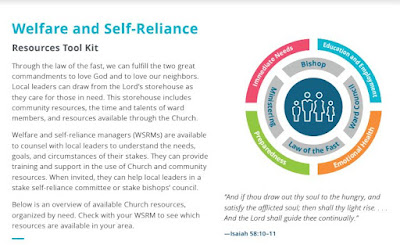
This diagram is part of the blueprint for Zion. It shows how the Church is organized with resources to provide for the needs of individuals to enable each Latter-day Saint to achieve his/her potential and be able to serve others. It's a beautiful, comprehensive system built on Gospel principles.

Everyone should become familiar with these resources, whether you need them or are able to help implement them to bless others.


Boring progress creates exceptional results


From Twitter:

Boring progress creates exceptional results.

Or, in other words, 

11 And also it is an imperative duty that we owe to all the rising generation, and to all the pure in heart—

12 For there are many yet on the earth among all sects, parties, and denominations, who are blinded by the subtle craftiness of men, whereby they lie in wait to deceive, and who are only kept from the truth because they know not where to find it—

13 Therefore, that we should waste and wear out our lives in bringing to light all the hidden things of darkness, wherein we know them; and they are truly manifest from heaven—

14 These should then be attended to with great earnestness.

15 Let no man count them as small things; for there is much which lieth in futurity, pertaining to the saints, which depends upon these things.

16 You know, brethren, that a very large ship is benefited very much by a very small helm in the time of a storm, by being kept workways with the wind and the waves.

(Doctrine and Covenants 123:11–16)


Building Zion from diversity


Thoughtful article from 2017, although it uses the bizarre image of Christ visiting the Mayans instead of the Nephites in Zarahemla.

Now Is the Time to Build Zion

https://www.deseret.com/2017/11/15/20623158/now-is-the-time-to-build-zion

Two people admire the painting "Christ Visits the Americas" by John Scott at Conference Center in March 2001. 
After Jesus Christ came, the Book of Mormon records that the  races and tribes dissolved until there were no more Lamanites or Nephites.
Two people admire the painting "Christ Visits the Americas" by John Scott at Conference Center in March 2001. After Jesus Christ came, the Book of Mormon records that the races and tribes dissolved until there were no more Lamanites or Nephites.
 Deseret News archives

Recently, our ward has been discussing the idea of building Zion. It was brought to the attention of the bishopric that some in our church congregation feel they cannot speak openly without ridicule. Others feel they are not educated enough to contribute to gospel discussions.

Our ward of The Church of Jesus Christ of Latter-day Saints is a diverse mix, both professionally and politically. It is one of the most dynamic and engaging wards I’ve attended. It is also one of the most service oriented. But clearly there is room to grow.

The recent underlying tension we’ve seen in our congregation is a microcosm of what is happening all over the country in communities, states and families. We see deep disparity in our ideologies. We can’t understand why others don’t share our viewpoint.

I don’t believe God created us in his image so that we would turn out like clones. To witness his creations is to recognize that God loves diversity. He finds beauty in both the giraffe and the zebra, the birch tree and the red maple. Variety is what makes the world a beautiful and interesting place. It is only natural that the church would include people with vastly different opinions and backgrounds, cultures and personalities.

I look to Adam and Eve as an example of two people who saw God’s commandments in different ways, yet walked side by side. Adam was a rule follower. He obeyed with exactness the commandments of his father. Eve was willing to ask more questions. She took a risk because she understood what was on the other side of that garden.

We need both the Adams and the Eves in the church, those willing to hold the line and those willing to look outside the prescribed boundaries. We need many other kinds of people: those who have a grasp of deep doctrine and those who understand with their simple faith, the lifelong members and those that bring the fire of new conversion to our meetings. There is room in this vast church for everyone.

The question then is, how can we make a unified whole out of so many varied pieces? How do we go about building Zion?

There are only a few times in scriptural history when God’s people achieved Zion. In the Book of Mormon, we read about the time after Jesus Christ came, when races and tribes dissolved until there were no more Lamanites or Nephites. The scriptures say, “they were in one, the children of Christ, and heirs to the kingdom of God” (4 Nephi 1:17). The ite-less people had “no contention in the land, because of the love of God which did dwell in the hearts of the people.”

In modern terms, abandoning the “ites” would mean abandoning the labels we affix to ourselves and others: Republican and Democrat, white-collar and blue, lower class and upper, liberal and conservative.

These labels are a worldly fixture. They say nothing about our spirits or our commitment to Christ. In the Americas, the people of Christ only fell out of their Zion state when they began again to distinguish themselves as separate groups.

In the Book of Moses, we read about the people of Enoch, a group so righteous that God lifted them to the heavens because they were too good for this world.

It is said of the people of Enoch that “the Lord called his people Zion, because they were of one heart and one mind, and dwelt in righteousness, and there was no poor among them” (Moses 7).

There are three things going on here: First, the people were of one heart and mind. This doesn’t mean they were the same, that they all voted down the party line. However, they had the same purpose, the same end goal. For a ward congregation, that goal should be to come unto Christ and build up the kingdom of God on the Earth.

Two, the people of Enoch were a righteous people. They walked the walk and obeyed the commandments.

Finally, there were no poor. This is a key to building Zion: no poor in heart, no poor in spirit, and all temporal needs were shared among them.

If we want to build that same kind of Zion in our congregations, we must ask ourselves: What do we bring to church on Sunday? Do we come with a willing heart, to teach and be taught? Do we come with eyes wide open for those who might need help?

We all bring our faults, ready to lay on the altar. Are we willing to bring our humility as well, to say “Lord, I believe; help thou mine unbelief”? Help thou my short-sightedness, my inability to understand people who voted for ____, who believe in pro ____, who make uncomfortable comments about ____.

To do so requires an incredible amount of love. We simply cannot get to that point on our own. It is not human nature. But Christ was there — he was always there — and we can look to him. Christ broke bread with the minority party, the outcasts and sinners. He called tax collectors to be his disciples. Who would that be to you — those who support President Donald Trump or the pro-choice feminists?

Recently, a friend gave a talk in sacrament in which she talked about a new bipartisan group called Better Angels. Better Angels was formed in 2016 to help bridge the divide between Republicans and Democrats. It calls on groups to create the type of environment in which conflict isn’t avoided, but transformed. The name for the group comes from Abraham Lincoln’s first inaugural address, on the eve of the Civil War when the country was ready to crack in half. These are his concluding words from that address:

“We are not enemies, but friends. We must not be enemies. Though passion may have strained, it must not break our bonds of affection. The mystic chords of memory will swell when again touched, as surely they will be, by the better angels of our nature.”

As church members, we must call upon the better angels of our nature. We cannot expect our country, community or congregation to change until we are willing to change. We must allow Christ to transform us. We know that it is possible.

Only then can we build Zion.


Resources #2 - My Foundation


This is a series looking at the resources available to the entire world, for anyone who seeks to help establish a Zion society. Here is a link:

https://www.churchofjesuschrist.org/share/church-resources?lang=eng

Today we'll discuss the second item: My Foundation for Self Reliance.


The manual is available here:

https://www.churchofjesuschrist.org/bc/content/ldsorg/topics/self-reliance/my-foundation-na-eng.pdf?lang=eng

"My Foundation helps individuals learn and live doctrinal principles that lead to spiritual and temporal self-reliance."

There are 12 chapters in the manual. Chapter 8 focuses on how to become one by serving together.


Resources for everyone in the world


A Zion society is available for everyone who seeks it. Here are resources available for everyone in the world. I posted this link before.

https://www.churchofjesuschrist.org/share/church-resources?lang=eng

There are 31 links on that page, each of which could be a blog post.

The first one discusses Pathway.

https://www.byupathway.org/invite


Share Church Resources

The Church offers various resources to help us temporally and spiritually and to become more like the Savior. These resources are available for anyone, regardless of their faith or interest in the Church.

1. Consider who you know who might benefit from the resources below.
2. Confirm with your local priesthood leader what is available.
3. Invite your friend to participate.

NOTE: Many of these resources are available online.


Missionaries establishing Zion


There is a movement underway around the world that is bringing about Zion. Thousands of senior citizens from various countries are volunteering to "Serve, lift and grow" as senior missionaries. 

We've seen senior missionaries on every inhabited continent. They're always happy, engaged, and enthusiastic. They are integrated with their local communities and church units. Because they come from different parts of the world, they are a bridge to understanding and unity world-wide.

Here's the link:

https://seniormissionary.churchofjesuschrist.org/srsite/?lang=eng

The page has these topics.

What are the options?

Explore over 30 meaningful missionary experiences—whether close to home or across the world—that will allow you to serve the Lord and bless others.

What is the best missionary opportunity for me?

Your needs and circumstances are unique. Answer a few simple questions about your specific situation and preferences to discover the best missionary opportunities for you. Log in with your Church Account for even better results.

Can I browse a list of opportunities?

Absolutely! Click below to view current missionary opportunities worldwide. You can set filters and search keywords to narrow the list.

_____

The Options page includes this explanation and these opportunities:

As a mature member of the Church, you likely have experience serving, teaching, and leading others and working to accomplish the Church's divinely appointed responsibilities of living the gospel of Jesus Christ, caring for those in need, inviting all to receive the gospel, and uniting families for eternity. You now have the opportunity to build on that experience as a senior missionary.

When reviewing the following service options, remember that "all things unto [the Lord] are spiritual" (D&C 29:34). Regardless of your specific assignment, as a missionary you will be called to represent the Lord and His Church.

PROVIDE HUMANITARIAN AID

Help provide desperately needed services and goods. Work with other organizations to assist in developing local humanitarian projects. Build relationships and coordinate with government, community, and charity organization leaders to determine critical local needs.

FEED THE HUNGRY

Provide for the hungry in the Lord's way at Church canneries, bakeries, and mills. Fill orders at bishops' storehouses, or help people build their food storage.

HELP PEOPLE BECOME SELF-RELIANT

Lift people from their current circumstances to a better life by helping them learn how to provide for themselves and their families. Foster self-respect and healing for those who are struggling with addictions, assist refugees and others in need, and help people improve their education, employment, and financial outlook.

USE YOUR PROFESSIONAL SKILLS

You have spent most of your life developing and using professional skills that are needed in many areas of the world. Your skills are needed to support missionaries, members, and communities worldwide.

SUPPORT YOUNG ADULTS

Strengthen the faith of youth and young adults with your testimony and life experience. Teach seminary and institute classes, operate and manage an institute, or support administration.


TEACH AND FELLOWSHIP


Minister one-on-one to help people understand and receive the blessings of living the gospel of Jesus Christ. Assignments include working in stakes and wards, at visitors' centers and historic sites, and with military families.

INTERACT WITH THE PUBLIC

Build positive impressions of the Church as you reach out to local communities or interact with visitors at Church sites. Assignments include public affairs, Church hosting, and guest services.

PRESERVE AND SHARE CHURCH HISTORY

Help collect and share the continuing history of the Church. Whether you interview modern Church pioneers, preserve records at the Church History Library in Salt Lake City, or share Church history at a historic site or library, you can be part of the effort to preserve Church history for future generations.

HELP PEOPLE FIND THEIR ANCESTORS

More people than ever before are participating in family history, and you can help them. Work with people one-on-one in a family history library or from home, help people find and prepare names for the temple, and train stake and ward family history leaders.

PRESERVE FAMILY HISTORY RECORDS

Every name in the temple came from a record. You can help preserve and digitize original records in archives and libraries, digitize and index books containing family history information, or prepare images to be uploaded to FamilySearch.